Account Abstraction for Everyone
Account Abstraction for Everyone
Account Abstraction for Everyone
Account Abstraction for Everyone
Account Abstraction for Everyone
Education
Education
Product
Product
Why is crypto still so hard to use?
Let’s start with a simple question: why is crypto so hard to use?
You want to swap a token. But first you need to: install a wallet extension. Write down 24 words. Buy ETH somewhere. Send it to your wallet. Switch to the right network. Approve the token. Sign the transaction. Hope nothing fails.
That’s not a product. That’s an obstacle course. And 95% of people quit before finishing it.
The real problem isn’t crypto
Ethereum has two types of accounts, and both are broken for normal people.
EOA (Externally Owned Account) — your regular wallet. Controlled by a single private key.
Lose it — everything’s gone. Someone gets it — everything’s gone. And you need ETH in it before you can do anything at all.
Contract Account — a smart contract that holds assets. More flexible, but can’t start transactions on its own. Just sits there.
For years these were the only options. Like choosing between a bicycle with no brakes and a car with no steering wheel.
Account Abstraction changes this completely.
It turns your wallet into a Smart Account — a programmable contract with custom rules.
Recovery options. Spending limits. Gasless transactions. Multiple signers. Whatever you need.
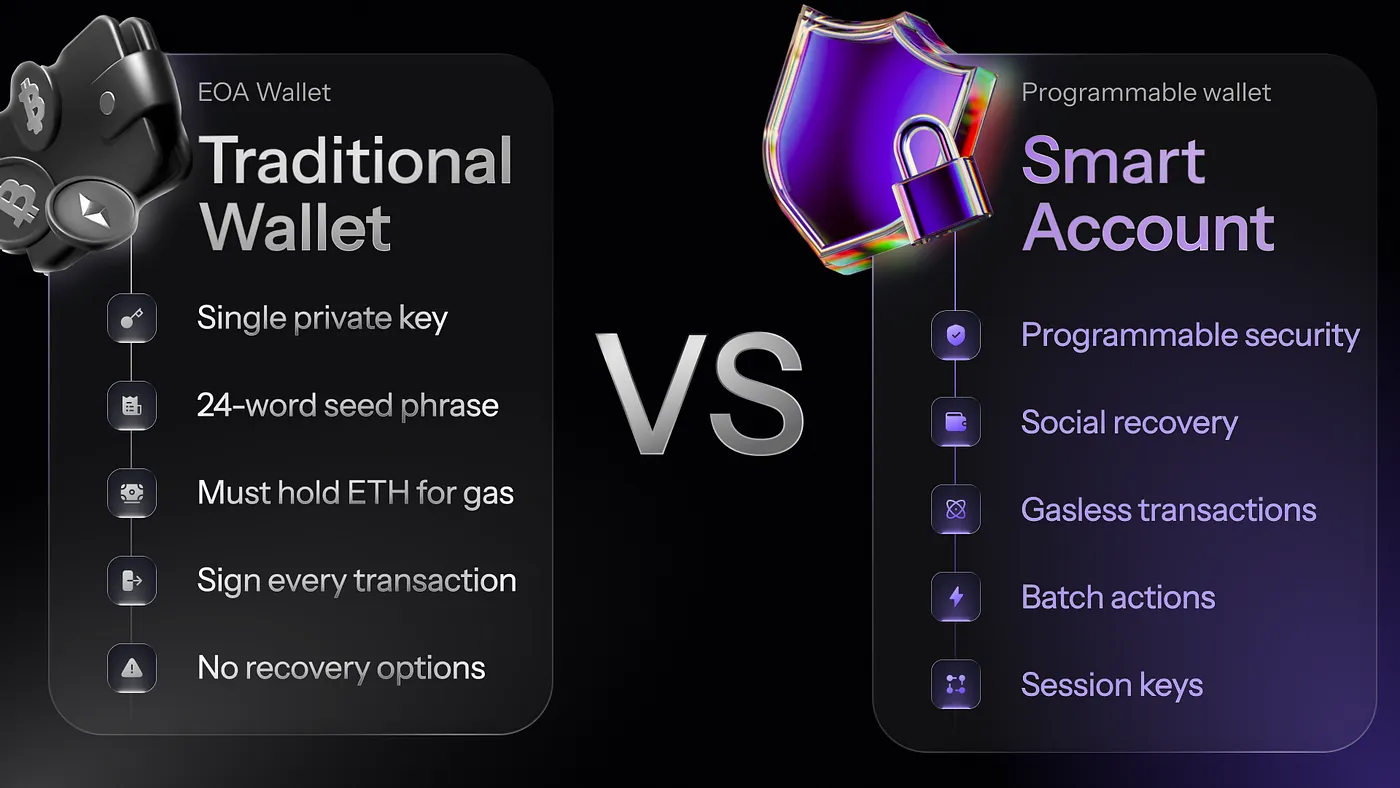
The standard that makes this possible is ERC-4337. It launched on Ethereum mainnet in March 2023 and has already powered over 100 million transactions across 40+ million smart accounts.
How ERC-4337 works
The technical architecture has several components, but here’s what matters:
1. UserOperation Instead of a normal transaction, you create a “UserOperation” — a request describing what you want to do.
2. Bundler A Bundler collects UserOperations from many users and submits them to the blockchain in one batch. You don’t need ETH — the Bundler handles it.
3. EntryPoint A smart contract that validates and executes UserOperations. It checks signatures, calls your smart account, and handles gas payment.
4. Paymaster (optional) A contract that can sponsor gas fees. Apps can pay for their users. Users can pay in stablecoins instead of ETH.
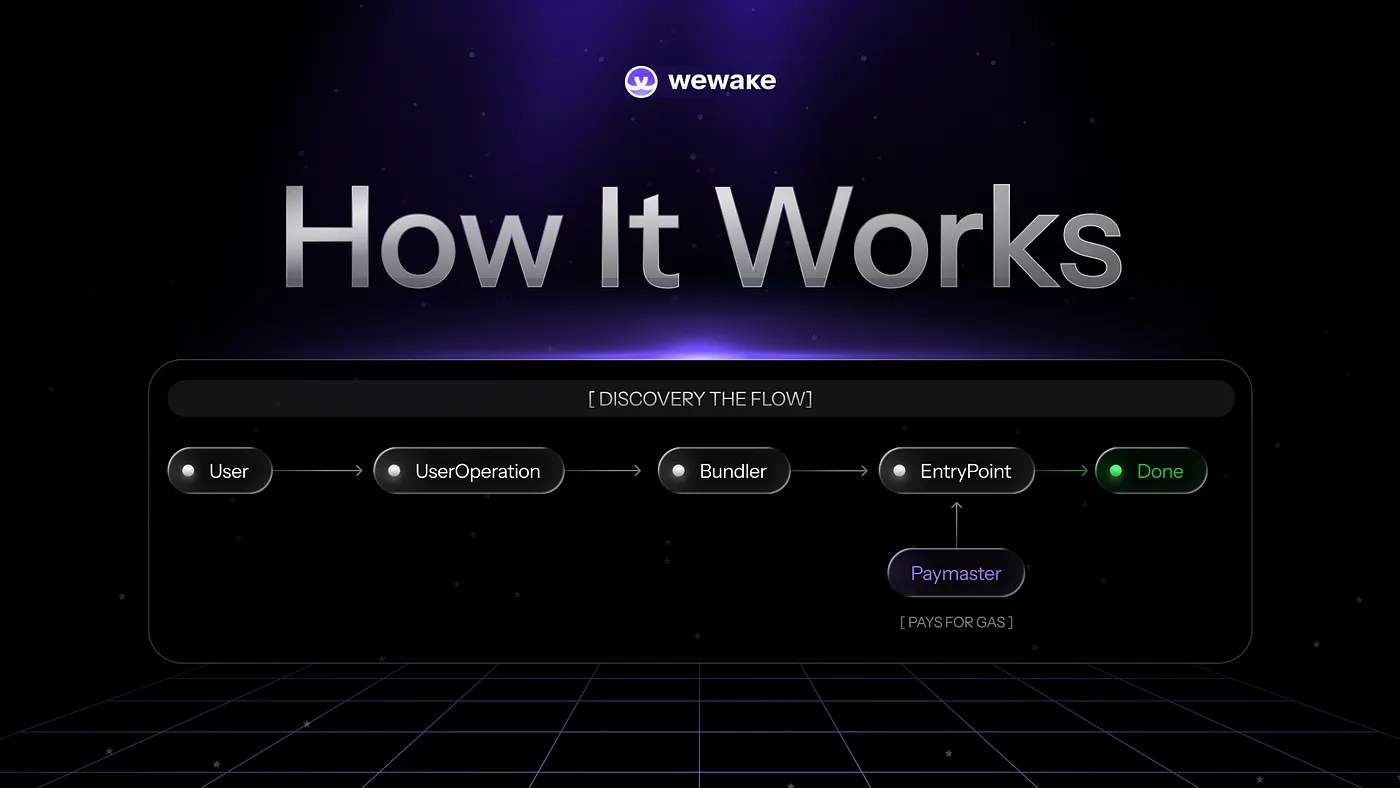
From the user’s perspective: they clicked a button. Something happened. Done.
How WeWake implements this
We took ERC-4337 and made it disappear.
Walletless onboarding. Sign in with Google, Telegram, or Email. No wallet extension. No seed phrase. A smart account is created in the background — you don’t even know it happened.
Gasless by default. Every transaction goes through our Paymaster. Users never see gas prompts. Apps set budgets and rules: who gets sponsored, for what actions, how much per day.
WakeKey MPC recovery. Your keys are never in one place. We split them 2-of-3: one share on your device, one encrypted in your cloud, one with WeWake (rate-limited, can’t act alone). You can always recover.
Session keys. Apps request limited permissions — specific contracts, time windows, spending caps. Sign once, interact freely within those limits. Perfect for games, bots, recurring payments.
WakeGuard AI. Risk scoring before sponsorship. Bots and sybils get flagged. Real users get free gas. Important: AI only influences whether gas gets sponsored — never transaction validity. That’s pure cryptography.
Classic flow: Install wallet → Seed phrase → Buy ETH → Switch network → Approve → Sign → Pray
WeWake flow: Login → Do the thing
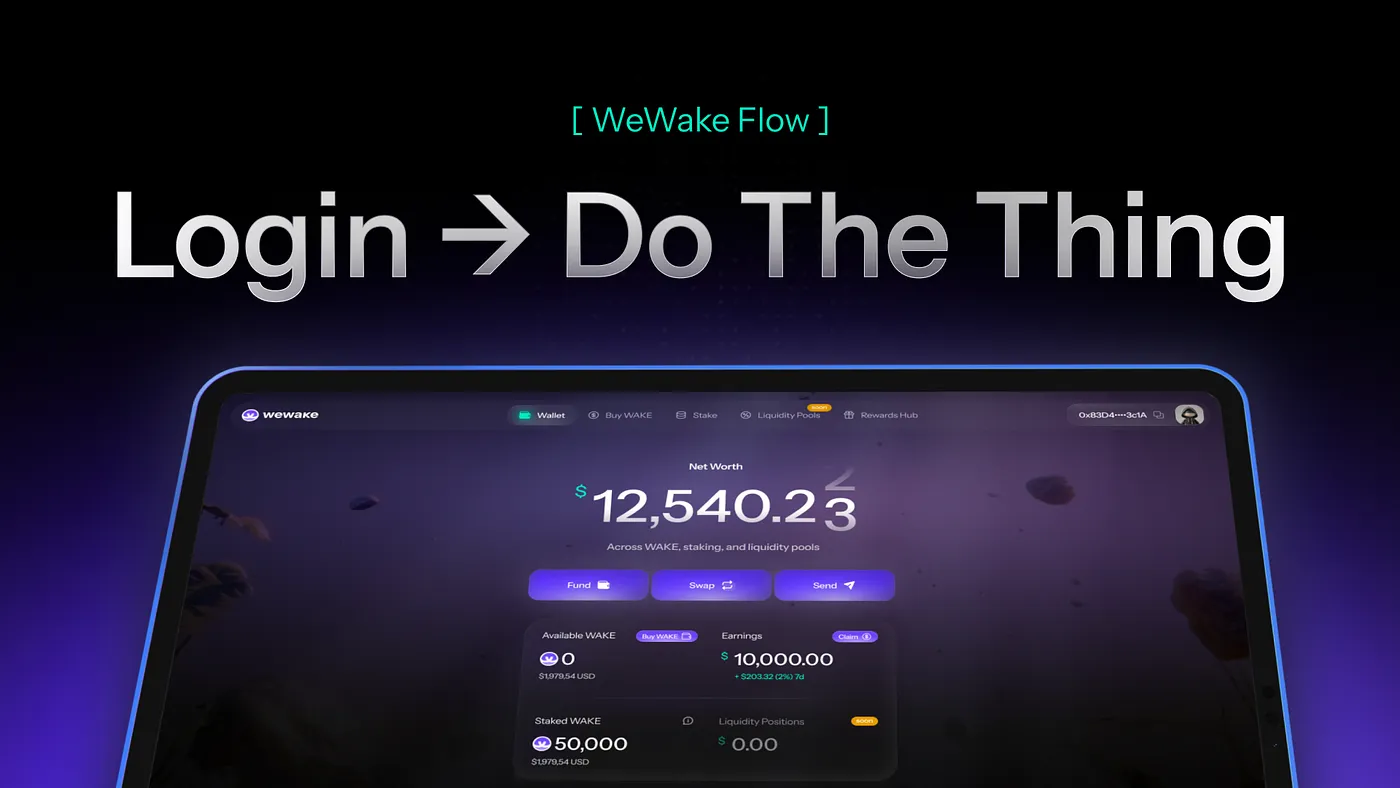
That’s it. That’s the product.
The next billion users won’t know they’re on a blockchain
Think about how you use the internet. You open an app. You don’t configure DNS. You don’t think about TCP/IP. It just works.
That’s where crypto needs to go. And Account Abstraction is how it gets there.
ERC-4337 is the standard. Smart accounts are the primitive. Paymasters are the economic layer. Session keys are the UX layer.
WeWake puts it all together into infrastructure that developers ship in days, not months.
No seed phrases. No gas prompts. No wallet extensions.
Login and do the thing. That’s crypto for everyone.
Why is crypto still so hard to use?
Let’s start with a simple question: why is crypto so hard to use?
You want to swap a token. But first you need to: install a wallet extension. Write down 24 words. Buy ETH somewhere. Send it to your wallet. Switch to the right network. Approve the token. Sign the transaction. Hope nothing fails.
That’s not a product. That’s an obstacle course. And 95% of people quit before finishing it.
The real problem isn’t crypto
Ethereum has two types of accounts, and both are broken for normal people.
EOA (Externally Owned Account) — your regular wallet. Controlled by a single private key.
Lose it — everything’s gone. Someone gets it — everything’s gone. And you need ETH in it before you can do anything at all.
Contract Account — a smart contract that holds assets. More flexible, but can’t start transactions on its own. Just sits there.
For years these were the only options. Like choosing between a bicycle with no brakes and a car with no steering wheel.
Account Abstraction changes this completely.
It turns your wallet into a Smart Account — a programmable contract with custom rules.
Recovery options. Spending limits. Gasless transactions. Multiple signers. Whatever you need.
The standard that makes this possible is ERC-4337. It launched on Ethereum mainnet in March 2023 and has already powered over 100 million transactions across 40+ million smart accounts.
How ERC-4337 works
The technical architecture has several components, but here’s what matters:
1. UserOperation Instead of a normal transaction, you create a “UserOperation” — a request describing what you want to do.
2. Bundler A Bundler collects UserOperations from many users and submits them to the blockchain in one batch. You don’t need ETH — the Bundler handles it.
3. EntryPoint A smart contract that validates and executes UserOperations. It checks signatures, calls your smart account, and handles gas payment.
4. Paymaster (optional) A contract that can sponsor gas fees. Apps can pay for their users. Users can pay in stablecoins instead of ETH.
From the user’s perspective: they clicked a button. Something happened. Done.
How WeWake implements this
We took ERC-4337 and made it disappear.
Walletless onboarding. Sign in with Google, Telegram, or Email. No wallet extension. No seed phrase. A smart account is created in the background — you don’t even know it happened.
Gasless by default. Every transaction goes through our Paymaster. Users never see gas prompts. Apps set budgets and rules: who gets sponsored, for what actions, how much per day.
WakeKey MPC recovery. Your keys are never in one place. We split them 2-of-3: one share on your device, one encrypted in your cloud, one with WeWake (rate-limited, can’t act alone). You can always recover.
Session keys. Apps request limited permissions — specific contracts, time windows, spending caps. Sign once, interact freely within those limits. Perfect for games, bots, recurring payments.
WakeGuard AI. Risk scoring before sponsorship. Bots and sybils get flagged. Real users get free gas. Important: AI only influences whether gas gets sponsored — never transaction validity. That’s pure cryptography.
Classic flow: Install wallet → Seed phrase → Buy ETH → Switch network → Approve → Sign → Pray
WeWake flow: Login → Do the thing
That’s it. That’s the product.
The next billion users won’t know they’re on a blockchain
Think about how you use the internet. You open an app. You don’t configure DNS. You don’t think about TCP/IP. It just works.
That’s where crypto needs to go. And Account Abstraction is how it gets there.
ERC-4337 is the standard. Smart accounts are the primitive. Paymasters are the economic layer. Session keys are the UX layer.
WeWake puts it all together into infrastructure that developers ship in days, not months.
No seed phrases. No gas prompts. No wallet extensions.
Login and do the thing. That’s crypto for everyone.
Why is crypto still so hard to use?
Let’s start with a simple question: why is crypto so hard to use?
You want to swap a token. But first you need to: install a wallet extension. Write down 24 words. Buy ETH somewhere. Send it to your wallet. Switch to the right network. Approve the token. Sign the transaction. Hope nothing fails.
That’s not a product. That’s an obstacle course. And 95% of people quit before finishing it.
The real problem isn’t crypto
Ethereum has two types of accounts, and both are broken for normal people.
EOA (Externally Owned Account) — your regular wallet. Controlled by a single private key.
Lose it — everything’s gone. Someone gets it — everything’s gone. And you need ETH in it before you can do anything at all.
Contract Account — a smart contract that holds assets. More flexible, but can’t start transactions on its own. Just sits there.
For years these were the only options. Like choosing between a bicycle with no brakes and a car with no steering wheel.
Account Abstraction changes this completely.
It turns your wallet into a Smart Account — a programmable contract with custom rules.
Recovery options. Spending limits. Gasless transactions. Multiple signers. Whatever you need.
The standard that makes this possible is ERC-4337. It launched on Ethereum mainnet in March 2023 and has already powered over 100 million transactions across 40+ million smart accounts.
How ERC-4337 works
The technical architecture has several components, but here’s what matters:
1. UserOperation Instead of a normal transaction, you create a “UserOperation” — a request describing what you want to do.
2. Bundler A Bundler collects UserOperations from many users and submits them to the blockchain in one batch. You don’t need ETH — the Bundler handles it.
3. EntryPoint A smart contract that validates and executes UserOperations. It checks signatures, calls your smart account, and handles gas payment.
4. Paymaster (optional) A contract that can sponsor gas fees. Apps can pay for their users. Users can pay in stablecoins instead of ETH.
From the user’s perspective: they clicked a button. Something happened. Done.
How WeWake implements this
We took ERC-4337 and made it disappear.
Walletless onboarding. Sign in with Google, Telegram, or Email. No wallet extension. No seed phrase. A smart account is created in the background — you don’t even know it happened.
Gasless by default. Every transaction goes through our Paymaster. Users never see gas prompts. Apps set budgets and rules: who gets sponsored, for what actions, how much per day.
WakeKey MPC recovery. Your keys are never in one place. We split them 2-of-3: one share on your device, one encrypted in your cloud, one with WeWake (rate-limited, can’t act alone). You can always recover.
Session keys. Apps request limited permissions — specific contracts, time windows, spending caps. Sign once, interact freely within those limits. Perfect for games, bots, recurring payments.
WakeGuard AI. Risk scoring before sponsorship. Bots and sybils get flagged. Real users get free gas. Important: AI only influences whether gas gets sponsored — never transaction validity. That’s pure cryptography.
Classic flow: Install wallet → Seed phrase → Buy ETH → Switch network → Approve → Sign → Pray
WeWake flow: Login → Do the thing
That’s it. That’s the product.
The next billion users won’t know they’re on a blockchain
Think about how you use the internet. You open an app. You don’t configure DNS. You don’t think about TCP/IP. It just works.
That’s where crypto needs to go. And Account Abstraction is how it gets there.
ERC-4337 is the standard. Smart accounts are the primitive. Paymasters are the economic layer. Session keys are the UX layer.
WeWake puts it all together into infrastructure that developers ship in days, not months.
No seed phrases. No gas prompts. No wallet extensions.
Login and do the thing. That’s crypto for everyone.
How to share your referral link like a PRO
How to share your referral link like a PRO
At WeWake, every user gets a referral link that pays 15% in WAKE on every qualifying purchase made through it. no cap. no expiry. no tiers to unlock. just share, and earn.
At WeWake, every user gets a referral link that pays 15% in WAKE on every qualifying purchase made through it. no cap. no expiry. no tiers to unlock. just share, and earn.
Community
Product
How to Join Presale & Stake $WAKE
How to Join Presale & Stake $WAKE
Most presale tokens give you one thing: hope. You buy, you wait, you check the price every day. Maybe it lists. Maybe it doesn’t. Either way, your tokens just sit there — and you can’t do anything...
Most presale tokens give you one thing: hope. You buy, you wait, you check the price every day. Maybe it lists. Maybe it doesn’t. Either way, your tokens just sit there — and you can’t do anything...
Update
Product
You Don’t Need a Seed Phrase — Here’s Why That’s Safe
You Don’t Need a Seed Phrase — Here’s Why That’s Safe
The setup takes 30 seconds. You get random words. You decide how to store them. And that decision is permanent. No reset. No support. No second chance.
The setup takes 30 seconds. You get random words. You decide how to store them. And that decision is permanent. No reset. No support. No second chance.
Education
Product
How to share your referral link like a PRO
At WeWake, every user gets a referral link that pays 15% in WAKE on every qualifying purchase made through it. no cap. no expiry. no tiers to unlock. just share, and earn.
Community
Product
How to Join Presale & Stake $WAKE
Most presale tokens give you one thing: hope. You buy, you wait, you check the price every day. Maybe it lists. Maybe it doesn’t. Either way, your tokens just sit there — and you can’t do anything...
Update
Product
©2026 WeWAKE • Designed to help users move from holding assets to earning.
WeWake provides infrastructure and tools, not investment advice.
©2026 WeWAKE • Designed to help users move from holding assets to earning.
WeWake provides infrastructure and tools, not investment advice.
©2026 WeWAKE • Designed to help users move from holding assets to earning.
WeWake provides infrastructure and tools,
not investment advice.
Product
Company
Resources
Product
Company
Resources